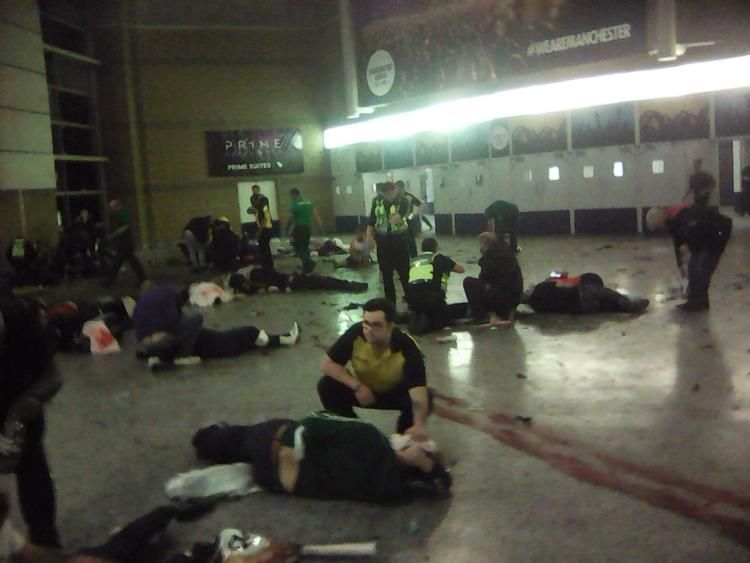
It didn’t take long for the BBC to marshal the troops gathering together a veritable army of voices ready to spin us the usual platitudes and lies. The Today show rolled ’em out one after the other.
There was Richard Barrett, ex-MI6, who told us we need to understand and engage with the Muslim community and understand what the intention was behind the attack….really? After all this time we’re still having to ask that? C4 just told us…ISIS is Islamic and want to Islamise the world. Not hard is it? He went on to say the answer was to let the Muslim community inform us on how to deal with the threat…yep, that’ll work. Just who does he think in the Muslim community will be the credible voices we should listen to? Mo Ansar, Cage, MPACUK, anti-Semitic Labour MP’s, or maybe the Muslim Council of Britain which, as the BBC tells us, is the most representative body of Muslims in the UK?…and yet it is an extremist organisation which in 2007 drew up what is seen as a blue print for the Trojan Horse plot and the man who drew that up, MCB official, Tahir Alam, was central to the actual plot…never mind numerous other concerns about the MCB such as how they portray Ahmadis.
The BBC insisted that the Trojan Horse plot was fake, a hoax….Phil Mackie declared it was the result of racism, Islamophobia and paranoia..
 Trouble is it was real, all too real….and perhaps one fact, that Muslim pupils were being taught that non-Muslim white women were ‘prostitutes’, might help inform us as to why a concert full of what were mostly girls is deemed to be a suitable target for fundamentalists.
Today the MCB laughably suggest Muslims alone have been battling extremism…and that Islam has nothing to do with any of this…We Muslims can’t combat the poison of terrorism alone.
The BBC knows Barrett is a ‘reliable’ voice…but just why do the Intelligence Services spin us this lie about there being no connection between Islam and extremism?
The Telegraph tells us of the truth…
People in MI5 tell me that denying the connection between Islamism and terrorism derives from the belief that if you accept it, there’s no hope for a multicultural society in Britain: we would just have to recognise that part of the population is permanently liable to become terrorists.
We know the Establishment is lying to us about Islam, that ‘religion of peace’…nice to have it confirmed.
After Barrett we had Tessa Jowell and Nick Robinson doing a double act attacking social media for giving a platform to people who spread hate and division, people who have already decided who is to blame and know what should be done…er…the BBC has already admitted it was ‘Muslim’ and decided we should let Muslims get on with policing themselves….hmmm…perhaps we should really be looking at that other ‘social media’…the mosques, madrassas, faith schools and the ‘dinner table’ test where anger about British foreign policy, Israel and Western decadent culture is acceptable.
Then we were told that the real problem is the Far Right and the mythical ‘backlash’….apparently Le Pen welcomed such attacks and wanted to benefit from them…the Far-Right must be dealt with. Perhaps we shouldn’t focus though on the identity of the attacker. Hmmm….maybe, actually, we should be angry, enraged, furious, and not just with the bomber and those who peddle his ideology….maybe we should say we’ve had enough, we’re sick of this, we’re sick of being blamed, we’re sick of being blackmailed…sick of being bombed and told it’s our own fault…by the Muslim community and the BBC….
Brendan O’Neil in Spiked……
After Manchester: it’s time for anger
After the terror, the platitudes. And the hashtags. And the candlelit vigils. And they always have the same message: ‘Be unified. Feel love. Don’t give in to hate.’ The banalities roll off the national tongue. Vapidity abounds. A shallow fetishisation of ‘togetherness’ takes the place of any articulation of what we should be together for – and against. And so it has been after the barbarism in Manchester. In response to the deaths of more than 20 people at an Ariana Grande gig, in response to the massacre of children enjoying pop music, people effectively say: ‘All you need is love.’
As part of the post-terror narrative, our emotions are closely policed. Some emotions are celebrated, others demonised. Empathy – good. Grief – good. Sharing your sadness online – great. But hatred? Anger? Fury? These are bad. They are inferior forms of feeling, apparently, and must be discouraged. Because if we green-light anger about terrorism, then people will launch pogroms against Muslims, they say, or even attack Sikhs or the local Hindu-owned cornershop, because that’s how stupid and hateful we apparently are. But there is a strong justification for hate right now. Certainly for anger. For rage, in fact. Twenty-two of our fellow citizens were killed at a pop concert. I hate that, I hate the person who did it, I hate those who will apologise for it, and I hate the ideology that underpins such barbarism. I want to destroy that ideology.
Where’s the rage? If the massacre of children and their parents on a fun night out doesn’t make you feel rage, nothing will. The terrorist has defeated you. You are dead already.
Certainly no rage on the BBC….just attempts to cover the tracks and downplay the reality behind this terrorist attack. Nothing to see, move along, we will survive. So brave.
Then we had a Bishop on who blessed us with his insights…we must not be divided by this, we must not lose trust in each other, we must make sure there is no blame by association, no blame beyond the killers….any critic of Muslims is a racist troll who needs to be isolated along with their message of hate…oh…and love wins.
Then we had the politicians wth the same messages….we must not let them change our way of life. May told us that ‘our country, our way of life, our values will always prevail’. And yet that’s nonsense. The real threat is not the violent Jihad but the cultural one that slowly forces Society to Islamise in order to accomodate and appease Muslims…our culture, our society, our values are being gradually erased and replaced….Islamised.
We keep hearing that the intent of the terrorists is to sow fear and division…well that may be a welcome side-effect for them but the real intent is to Islamise Europe…they know that the effect of an attack is to send politicians and the Media into angst driven narratives about Muslims, asking what could have driven them to do such things….‘One lesson well understood in both Stalin’s Russia and Nazi Germany was that propaganda is most effective when it is backed by terror’. The answer?…discrimination, disaffection, marginalisation and Islamophobia…the solution…help Muslims integrate, feel more at home, feel more welcome. How to do this? By ‘Islamising’ society…making everything that ‘offends’ Muslims disappear, making society fit into Muslim demands and values rather than tell them that if you want to live here you change.
The MCB provides the perfect illustration of this with their 2007 Trojan horse ‘blueprint’ as it demands schools adapt to suit Islam….making Britons ‘virtual Muslims’…
The MCB’s contribution in publishing its report, Towards Greater Understanding, is wholly consistent with the government’s “Every Child Matters” strategy, and complementary to it. The result of meeting Muslim needs in mainstream schools is that Islam and Muslims become a normal part of British life and that we become fully integrated in this way.
Or as another Muslim group said…basically surrender or maybe angry Muslims will be radicalised and…..
“If you give us religious rights we will be in a better position to convince young people that they are being treated equally along with other citizens.”
Or how about changing our foreign policy to suit the bombers…who aren’t Muslims of course but somehow represent Muslim opinion…..
The group of prominent Muslims who penned an open letter suggesting Muslim youths are alienated by Britain’s foreign policy, so it should be changed.
Why exactly? To placate a handful of home-grown terrorists and terrorist sympathisers?
In other words the rest of us can only be safe if THEY get a foreign policy that suits them. The Mafia would call this extortion. Give us what we want and we’ll do our best to stop the baddies blowing you up.
The loud cries about the danger of such attacks being used to divide us are hopelessly off the mark. The attacks don’t divide us, the attacks are a result of the divisions that already exist, divisions created by an ideology that puts a vast, unbridgeable gap between Muslims and non-Muslims…Trevor Phillips has already spelt that out..the Muslim ghettoes, the parallel societies growing bigger and further apart, the closed societies breeding fundamentalism which has been growing since the 1980’s.
Britain is well on its way to Talibanisation in many areas...as said, the violence is not the real problem..the intent behind that violence is an intent shared by the ‘non-violent’ as well…. Islamisation….
The rapid spread of rigid, diehard Islam [In the UK] is deeply worrying. Yet those in power, focused on terrorist cells, seem oblivious to this other peril…. our politicians and Muslim ‘leaders’ allow their twisted ideology to spread across Britain.
Make no mistake, Taliban devotees are in our schools, playgrounds, homes, mosques, political parties, public service, private firms and universities.
And if we are to have any hope of combating them, we need to stop this attitude of appeasement and understand why so many Muslims are attracted to the most punishing forms of belief, suppressing women and children.
If this was happening in any other nation, we would be condemning it loudly.
Yet here, curtailed and deficient education endured by many Muslim children is seen as a religious entitlement, which, if opposed, apparently confirms Islamophobia.
Why are we fighting the Taliban in Afghanistan and indulging Taliban values here?
Even if it offends liberal principles, the powerful must find a way of stopping Islamicists from promulgating their distorted creed.
The Mirror way back in 2006 understood the problem and understood that ‘Community leaders’ were not the answer…indeed they were part of the problem…
AS the country vexes itself over how to deal with the radicalisation of British-born Muslim youths, it’s revealing to know some of their leaders believe they have the answer.
The introduction of Sharia Law in Britain along with important religious days in the Muslim calendar becoming public holidays for followers of the faith should do the trick, or so claims the secretary general of the Union of Muslim Organisations in the UK and Ireland.
As Dr Syed Aziz Pasha says: “If you give us religious rights we will be in a better position to convince young people that they are being treated equally along with other citizens.”
This sounds perilously close to blackmail.
In the end if politicians and the media keep lying to people the people will take things into their own hands.
‘Backlash’ might not be a word that fully describes what might happen as the great experiment finally fails.
“Violence can only be concealed by a Lie, & the Lie can only be maintained by Violence.“
It can’t end well.