“Thanks to Israel, I Can Have a Merry Christmas,” by Father Gabriel Nadaf (translated by Avi Woolf), Mida.org, December 24, 2014:
A safe haven in Israel
Within this chaos, only one island of sanity can be found where the Christians are not persecuted, where they enjoy freedom of religion and ritual, freedom of expression, and where they can live in peace without fear of genocide. That island is the State of Israel. The state in which I and my Christian brothers were born allows Christians complete freedom. Jews and Christians live in Israel in peace and as good neighbors. This is not just because Jesus was born in Jewish Bethlehem and was born a Jew, but because Christians and Jews share a common heritage and a shared hope for a peaceful coexistence.
From the Telegraph:
Christians in the Holy Land have handed a dossier detailing incidents of violence and intimidation by Muslim extremists to Church leaders in Jerusalem, one of whom said it was time for Christians to “raise our voices” against the sectarian violence.
The dossier includes 93 alleged incidents of abuse by an “Islamic fundamentalist mafia” against Palestinian Christians, who accused the Palestinian Authority of doing nothing to stop the attacks.
The Christian community was faced with “very brutal” adversaries. “A criminal mafia and Islamic fundamentalists work together,” he said. “Their interests met to take our land away.”
“The Christian community has always suffered in the last few years because we are a minority. Many have the temptation to leave, so the community is shrinking.”
Several Christians tell the story of a moderate Muslim imam in Bethlehem’s biggest mosque, who was repeatedly threatened after giving a sermon calling for an end to the anti-Christian discrimination and land grabs.
Last weekend, the Christian village of Taybeh was ransacked and burned by a Muslim mob, incensed that a boy there had been seeing a girl from their neighbouring village of Deir Jarir.
Remember that as you consider the BBC’s Yolande Knell’s impartial, accurate and unbiased reporting…….
Yolande Knell has a habit of spouting rubbish….to the detriment of Israel naturally. You might think her boss would have reined her in by now…but her boss being the equally unreliable Jeremy Bowen you might understand how she has been allowed to keep her job….having said that, the example of Jon Donnison, shipped out to Australia and yet still publishing poisonous anti-Israeli material on the BBC payroll, shows being removed from the scene of the crime doesn’t mean you have to stop peddling your prejudices.
Knell was reporting from Bethlehem (11:36) and declared that the Christians there were quickly disappearing…due solely to the Israeli occupation, no other cause is suggested:
Their dwindling numbers in the Holyland add a sense of urgency to their celebrations….nowadays many young people in the West Bank choose to emigrate complaining of difficult social and economic conditions created by Israel’s occupation.
This is the same Knell who told us that:
However, Israel’s security concerns mean that most tourists must enter the Palestinian city of Bethlehem from Jerusalem, crossing an Israeli checkpoint and passing the eight-metre high West Bank barrier which surrounds the town.
Trouble is the Israeli security barrier does not ‘surround the town’ as demonstrated by this map….the thick red line being the path of the wall:
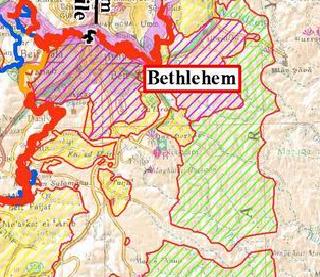
Is Bethlehem under Israeli occupation?
It has been under Palestinian Authority rule since 1995 as the Guardian reports...note the warning of what might be the result of that takeover:
There will be no star over Bethlehem this Christmas. The Israeli flag, which has flown over Manger Square for 28 years, was lowered yesterday for the last time, as the town was handed over to the Palestinian self-rule authority.
As the last small contingent of paramilitary forces moved out, Manger Square was filled with wildly celebrating crowds
On the outside a thick crust of spectators responded gleefully to every [sign of Israeli withdrawal]
There has been speculation that the coming of the PLO to Bethlehem will speed the exodus of Christians from the West Bank. But there was little sign of rivalry yesterday. Samir Sharer, one local Christian, said he was convinced that this year’s Christmas would be joyful. “Everything will be OK – no problem, no fights,” he said, before rather spoiling the effect by saying he would spend the holiday in Israel.
So what of her claim that Palestinian Christians are leaving the West Bank solely because of the Israeli occupation?
It’s, as much of her reporting, just not true.
Certainly the conditions don’t help…but what created the economic difficulties? The Palestinian war against Israel…
The outbreak of the Second Intifada and the resultant decrease in tourism also affected the Christian minority, as they are the owners of many Bethlehem hotels and services that cater to foreign tourists.
Where might Knell be getting her information? Could it possibly be the Palestinian propaganda groups ‘ The Palestinian Centre for Research and Cultural Dialogue’ and ‘Open Bethlehem’ which come up with this…..
In 2006, the Palestinian Centre for Research and Cultural Dialogue conducted a poll among the city’s Christians according to which 90% said they had had Muslim friends, 73.3% agreed that the PNA treated Christian heritage in the city with respect and 78% attributed the exodus of Christians to the Israeli blockade.
So to be clear…Israel causes the exodus of Christians whilst the Palestinian Authority treats the Christians with dignity and respect….yeah…right!
Why might Palestinian Christians toe the PA line?….
“Under Islam, the targeted dhimmi community and each individual in it are made to live in a state of perpetual humiliation in the eyes of the ruling community.” As described by a Christian Lebanese president, Bashir Gemayil: “a Christian…is not a full citizen and cannot exercise political rights in any of the countries which were once conquered by Islam.”
As Sir John Chancellor, British High Commissioner in Palestine, put it in 1931:“Christian Arab leaders, moreover, have admitted to me that in establishing close relations with the [Palestinian] Moslems the Christians have not been uninfluenced by fears of the treatment they might suffer at the hands of the Moslem majority in certain eventualities.”
Here is what a spokeswoman for ‘Open Bethlehem’ concludes:
Leila Sansour, Open Bethlehem’s Chief Executive, said: “Our survey of Bethlehem’s own citizens shows the city cannot retain this heritage and its Christian community while the wall remains.
She continued: “The choice is stark. Either the wall stays and Bethlehem ceases to be a Christian town. Or Bethlehem retains its Christian population ? in which case the wall has to come down.”
Pretty clear where she is coming from….so you might think it odd that the impartial BBC’s Yolande Knell works so closely with ‘Open Bethlehem’:
From BBCWatch:
‘Open Bethlehem’ is a political campaign which describes its aim as being “to address the state of emergency in Bethlehem”.
“Palestinian director Leila Sansour has made a fierce, poignant film about her family and her hometown of Bethlehem, now in Palestinian territory but progressively stifled by the Israeli government’s anti-terrorist barrier…”

Now, what would the BBC’s editorial guidelines on impartiality have to say about the self conscription of a BBC correspondent to a political campaign directly connected to the field she covers?
Whether or not Yolande Knell got the required permission from her Head of Department before agreeing to allow her name and BBC brand-linked title to be used for promotion of the ‘Open Bethlehem’ film we do not know. What is clear, however, is that her position as an ‘impartial’ BBC correspondent based in its Jerusalem bureau is compromised and indeed untenable after such political activity.
Here are some reports from Bethlehem which explore the issues more truthfully and attribute the blame more evenly:
Joseph Canawati is not looking forward to Christmas.
The expansive lobby of his 77-room Hotel Alexander is empty and he says: “There is no hope for the future of the Christian community.
“We don’t think things are going to get better. For us, it is finished.”
Life for Palestinian Christians such as 50-year-old Joseph has become increasingly difficult in Bethlehem – and many of them are leaving.
The town’s Christian population has dwindled from more than 85 per cent in 1948 to 12 per cent of its 60,000 inhabitants in 2006.
There are reports of religious persecution, in the form of murders, beatings and land grabs.
Meanwhile, the breakdown in security is putting off tourists, leading to economic hardship for Christians, who own most of the town’s hotels, restaurants and souvenir shops.
The situation has become so desperate that the Archbishop of Canterbury, Dr Rowan Williams, and Cardinal Cormac Murphy O’Connor, the head of the Roman Catholic Church in England and Wales, are to lead a joint delegation to Bethlehem this week to express their solidarity with the beleaguered Christian populace.
The town, according to the Cardinal, is being “steadily strangled”.
The sense of a creeping Islamic fundamentalism is all around in Bethlehem.
George Rabie, a 22-year-old taxi driver from the Bethlehem suburb of Beit Jala, is proud of his Christianity, even though it puts him in daily danger.
Two months ago, he was beaten up by a gang of Muslims who were visiting Bethlehem from nearby Hebron and who had spotted the crucifix hanging on his windscreen.
“Every day, I experience discrimination,” he says. “
“It is a type of racism. We are a minority so we are an easier target. Many extremists from the villages are coming into Bethlehem.”
Jeriez Moussa Amaro, a 27-year-old aluminium craftsman from Beit Jala is another with first-hand experience of the appalling violence that Christians face.
Five years ago, his two sisters, Rada, 24, and Dunya, 18, were shot dead by Muslim gunmen in their own home.
The fear of attack has prompted many Christian families to emigrate, including Mr Canawati’s sister, her husband and their three children who now live in New Jersey in America.
Majed El Shafie, president of One Free World International, says some Christians are forced to cooperate with the terrorist group Hamas that rules Gaza in order to protect their families.
“The Christians in the Palestinian Authority areas [are] facing persecutions. Their homes, their churches they get attacked almost every day,” El Shafie explained.
According to El Shafie, the situation of Christians in the West Bank where the Palestinian Authority is in control is better. The PA wants support from the West so the leaders try to portray themselves as a “democratic country,” he said.
But El Shafie pointed to Bethlehem, the city of Jesus birth, where there has been a steady exodus of the Christian community for decades.
Bethlehem has become a “tourist zone” for the PA, he said. “Basically they don’t want the Christians there but they want the Christian tourists to come and to take their money.”
Persecuted Christians
Anti-Christian violence has increased, mostly caused by Islamic extremists, although Muslim-background believers face pressure from family, too. The authorities fail to uphold the rights of individual Christians, causing some to flee to safer areas. In Gaza, Christians are enticed into becoming Muslims, especially during Ramadan, with the offers of jobs, houses, wives and diplomas. Sometimes the approach is more violent. A Greek Orthodox monastery in Bethany, West Bank, was the repeated target of attacks, forcing the nuns to ask President Abbas to intervene.
Knell has a history of biased and inaccurate reporting that is far from what is expected of the BBC…her most recent reports do nothing to change that impression and indeed merely reinforce the thought that she is just a mouthpiece for the Palestinians.
In summary…Israel is not in charge of Bethlehem, the Palestinian Authority is. The security barrier does not ‘surround’ Bethlehem. The main reason for Christians fleeing the West Bank is due to Palestinian persecution of them.
All in all not a good day for Knell or the BBC.



