

How soon the BBC forgets…
Execution of a teenage girl
On 15 August, 2004, Atefah Sahaaleh was hanged in a public square in the Iranian city of Neka.
Her death sentence was imposed for “crimes against chastity”.
The state-run newspaper accused her of adultery and described her as 22 years old.
But she was not married – and she was just 16.
In a town like Neka, heavily under the control of religious authorities, Atefah – often seen wandering around on her own – was conspicuous.
It was just a matter of time before she came to the attention of the “moral police”, a branch of the Islamic Revolutionary Guard, whose job it is to enforce the Islamic code of behaviour on Iran’s streets.
Secret relationship
Being stopped or arrested by the moral police is a fact of life for many Iranian teenagers.
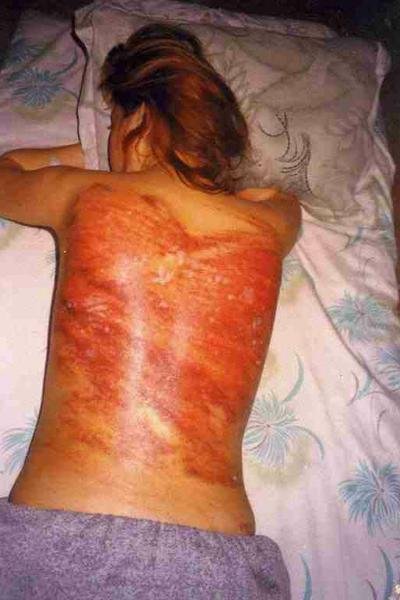
Previously arrested for attending a party and being alone in a car with a boy, Atefah received her first sentence for “crimes against chastity” when she was just 13.
Although the exact nature of the crime is unknown, she spent a short time in prison and received 100 lashes.
Who knew? The Iranian Islamic Revolution has freed women from their enslavement.
Craig at ‘Is the BBC biased?’ has a look at our old friend FOOC…
From this morning’s From Our Own Correspondent:
Kate Adie: Has the Ayatollah’s revolution in 1979 eventually helped Iranian women rather than hindered them?
The answer from FOOC was ‘yes’, it has helped them.‘Quite apart from overthrowing the corrupt and brutal regime of the Shah, the revolution introduced education reforms which have been of particular benefit to women. Amy Guttman’s been underground in the Iranian capital to see what can be learned about the lot of women in Iran today.’
Having to go ‘underground’ says quite a lot about Iran doesn’t it!
Did education help these women?

The Bahai Martyrs
In the Islamic Republic of Iran, teaching school may be hazardous to your health, if you are of the wrong religious faith. One would hope that in the modern world the horror stories of Christians being fed to the lions and Jews and Muslims being tortured on the rack would be a thing of the past. In Iran, the nightmare world of religious persecution is alive and well.
These young women of the Baha’i faith were convicted of the crime of teaching in a Bahai religious school and hanged in Shiraz Iran on June 18, 1983.
The women, ages 17 to 57, were led to the gallows one after the other. As there is “no compulsion in religion” under Islam, it is interesting that authorities were apparently hoping that as each woman saw the others slowly strangle to death, they would renounce their own faith. A rather persuasive argument of the superiority of Islam. But according to eyewitnesses, the women went to their fate singing and chanting.
How about this?….

Iranian Women Do Not Have the Right to Control Their Bodies
Since President Hassan Rouhani assumed office in August 2013, there has been a marked increase in state policies by hardliners in the government directly infringing upon the most basic rights of Iranian women. These hardliners, who dominate Parliament and are ensconced in the security, intelligence, and judicial branches of government, have focused in particular on two issues, both of which concern women’s bodies: the observance of “proper” hijab (Islamic dress) and the availability of family planning and women’s reproductive health services.
Possibly reliable Wikipedia suggests the BBC isn’t being totally honest either…
Women’s rights for Iranian women and their legal status has changed during different political and historical eras.
The Persian Constitutional Revolution
Iranian women played a significant role in the Persian Constitutional Revolution of 1905–11, which became a turning point in their lives. They participated in large numbers in public affairs and held important positions in journalism and in schools and associations that flourished from 1911 to 1924.[1] Prominent Iranian women who played a vital part in the revolution include Bibi Khatoon Astarabadi, Noor-ol-Hoda Mangeneh, Mohtaram Eskandari, Sediqeh Dowlatabadi, and Qamar ol-Molouk Vaziri.
Shah’s era
The shah’s government began its “White Revolution” in 1962 and ratified important women’s rights measures, including suffrage and the Family Protection Law of 1967, later amended more heavily in favor of women in 1975, which ended extrajudicial divorce and restricted polygamy.[3][4] It also raised the minimum age of marriage of girls to 18 that had been 13-15.
Women and the Iranian Revolution
Women participated heavily in the Iranian Revolution of 1979 that toppled the shah.
Not withstanding this, in the Islamic Republic of Iran, Ayatollah Khomeini severely curtailed rights that women had become accustomed to under the shah.[5] Within months of the founding of the Islamic Republic of Iran, the 1967 Family Protection Law was repealed; female government workers were forced to observe Islamic dress code; women were barred from becoming judges; beaches and sports were sex-segregated; the legal age of marriage for girls was reduced to 9 (later raised to 13); and married women were barred from attending regular schools.
Almost immediately women protested these policies.[5][8] The Islamic revolution is ideologically committed to inequality for women in inheritance and other areas of the civil code; and especially committed to segregation of the sexes. Many places, from “schoolrooms to ski slopes to public buses”, are strictly segregated.
The BBC is right that women in Iran have more access to education now but that comes not from the ‘Revolution’ but from reforms to the regime of the Revolution.
The BBC is being disengenuous here and is trying to paint the Islamic Revolution as a glorious thing for women when it wasn’t. Previous eras provided just as much momentum for women’s rights if not more…and the Shah’s regime was not merely a ‘corrupt and brutal regime’ as the BBC painted it….and it’s not as if the present regime is any better.
How happy is this woman to be under the protection of the Islamic Republic as she is about to be stoned to death for adultery?

And what about gay rights?

